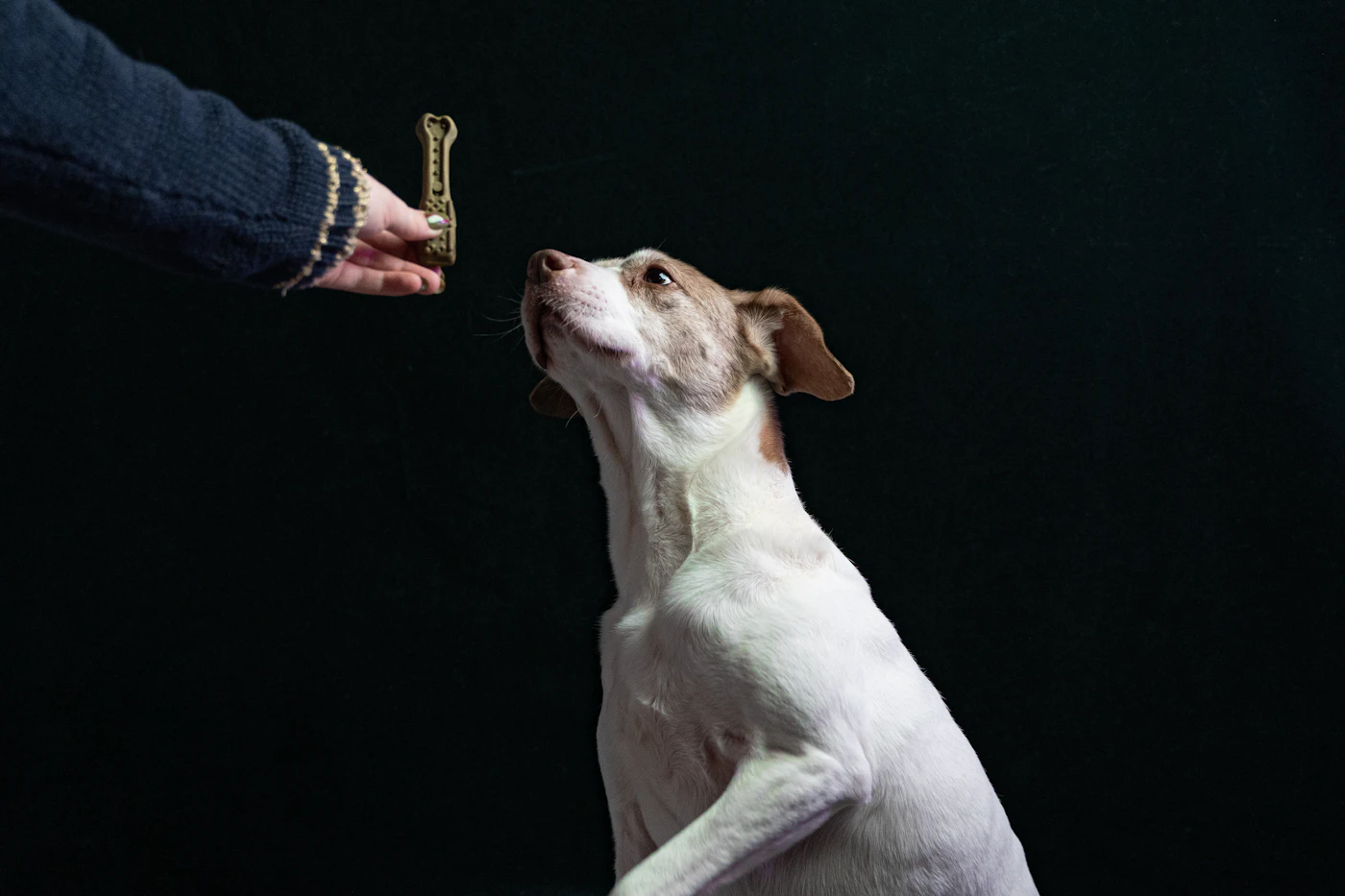
Positive reinforcement dog training is the approach veterinary behavior organizations recommend for all dog training (AVSAB, 2021), and it is also the one most often misunderstood. It is not about being soft, and it is not simply handing out treats. It is a specific way of changing behavior: when a behavior is followed by something the dog values, that behavior happens more often.
Key takeaways
- Reinforcement means more: if a behavior is not increasing, it was not reinforced.
- Timing is the skill: a marker word bridges the gap between the behavior and the reward.
- Value is relative: your dog decides what counts as a good reward, not you.
- Fade deliberately: thin out food rewards on purpose rather than stopping all at once.
- Build in small steps: shaping rewards each step toward a behavior instead of waiting for the finished result.
What positive reinforcement actually means
In behavior science, “positive” means something is added and “reinforcement” means the behavior becomes more likely. Put together, positive reinforcement is adding something the animal wants immediately after a behavior, so that behavior happens more in future. Food, play, sniffing, access to a door, attention and movement can all reinforce, depending on the dog and the moment. This learning process is known as operant conditioning: behavior changes because of what follows it.
The useful consequence of that definition is that you can test it. If you are handing out treats and the behavior is not increasing, something is wrong: the timing, the value of the reward, or the difficulty of what you are asking. Reinforcement is measured by results, not intentions.
Everyday examples of positive reinforcement in dog training
- Your dog sits while you pick up the leash, and the door opens for a walk.
- Your dog glances at you on a walk, you mark it and hand over a treat.
- Your dog comes when called and gets a thrown ball or a return to the interesting smell.
- Your dog settles on a mat and you quietly drop a treat between their paws.
The mechanics, in plain language
Marking the moment
A marker is a short, consistent signal that means “that, right there, earns a reward”. A clicker or a crisp “yes” both work. The marker solves a timing problem: you can mark the instant a paw lifts or a head turns, then take a second or two to deliver the food. Without a marker, dogs often learn the behavior that happened while you were reaching into your pocket.
Reinforcers and value
Rewards sit on a scale. Dry kibble might be enough for a sit in the kitchen. Coming away from another dog in a park is much harder work and deserves much better pay. Keep two or three tiers of reward and spend them where the work is hardest. Some dogs value a thrown toy or a few seconds of tug more than any food, and that is a reinforcer too. If you use food, count training treats toward your dog’s daily meals; our guide to building a healthy feeding routine covers meal planning.
Rate of reinforcement
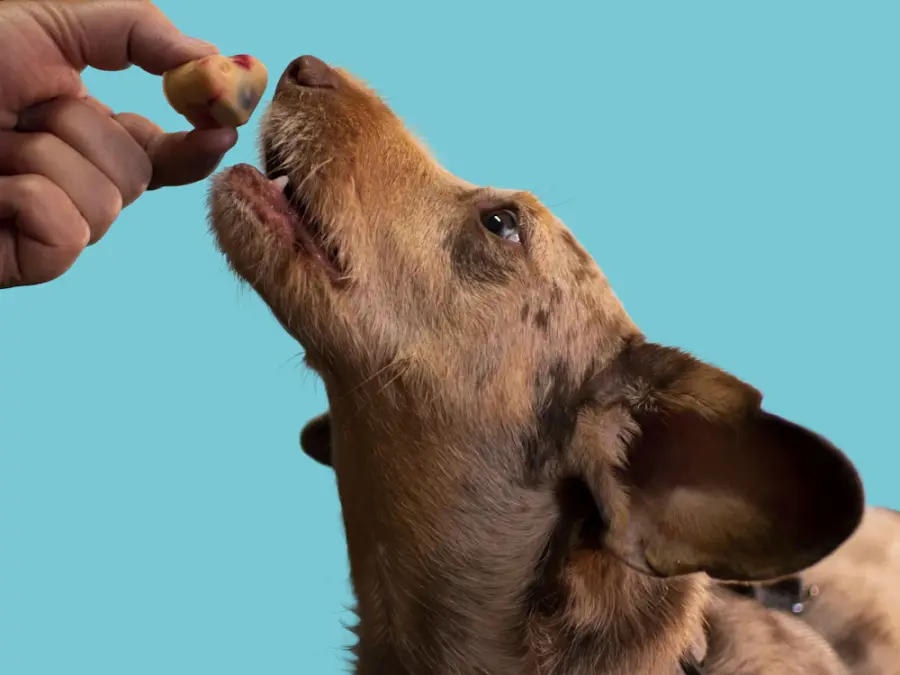
Early on, reward almost every correct repetition. A high rate keeps a dog engaged and makes the lesson clear. Once the behavior is fluent, you can start rewarding less predictably, which tends to make the behavior more persistent rather than less.
How to run a session
- Pick one behavior and one quiet location.
- Get your rewards ready and out of sight, in a pouch or pocket.
- Do ten to fifteen repetitions, marking and rewarding each success.
- If your dog fails twice in a row, make it easier.
- Finish on a success, put the rewards away and let your dog rest.
Two or three of these a day is more than enough. Short sessions also mean you can fit training into the gaps in a normal day instead of setting aside an hour you never have.
Fading the food
This is the part most owners skip, and it is why “he only does it for treats” is such a common complaint. Fade in stages rather than all at once.
| Stage | What you do | Why it matters |
|---|---|---|
| Learning | Reward every correct repetition | Makes the lesson clear and keeps your dog engaged |
| Fluency | Reward most repetitions, vary the size of the reward | Builds persistence without confusing the dog |
| Maintenance | Reward unpredictably, mix in praise and real-life rewards | Keeps the behavior strong without a full pouch of food |
| Everyday life | Pay occasionally, especially for hard repetitions | Stops the behavior quietly fading out over months |
Rewards that are not food
Food is convenient, not compulsory. Anything your dog will work for can reinforce a behavior, and using a wider range makes training fit real life.
- Sniffing. Releasing your dog to go and sniff a patch of grass is a powerful reward on a walk.
- Movement. Letting a dog carry on forwards is exactly what they wanted when they pulled, so it makes a good payment for walking nicely.
- Play. A few seconds of tug or a thrown toy suits dogs who find food boring outdoors.
- Doors and gates. Opening a door after a sit turns a daily routine into a training repetition.
- Attention. For dogs who love contact, a scratch in the right spot is genuinely valuable.
- Freedom. Being let off the long line rewards coming back, which is the opposite of what most owners accidentally teach.
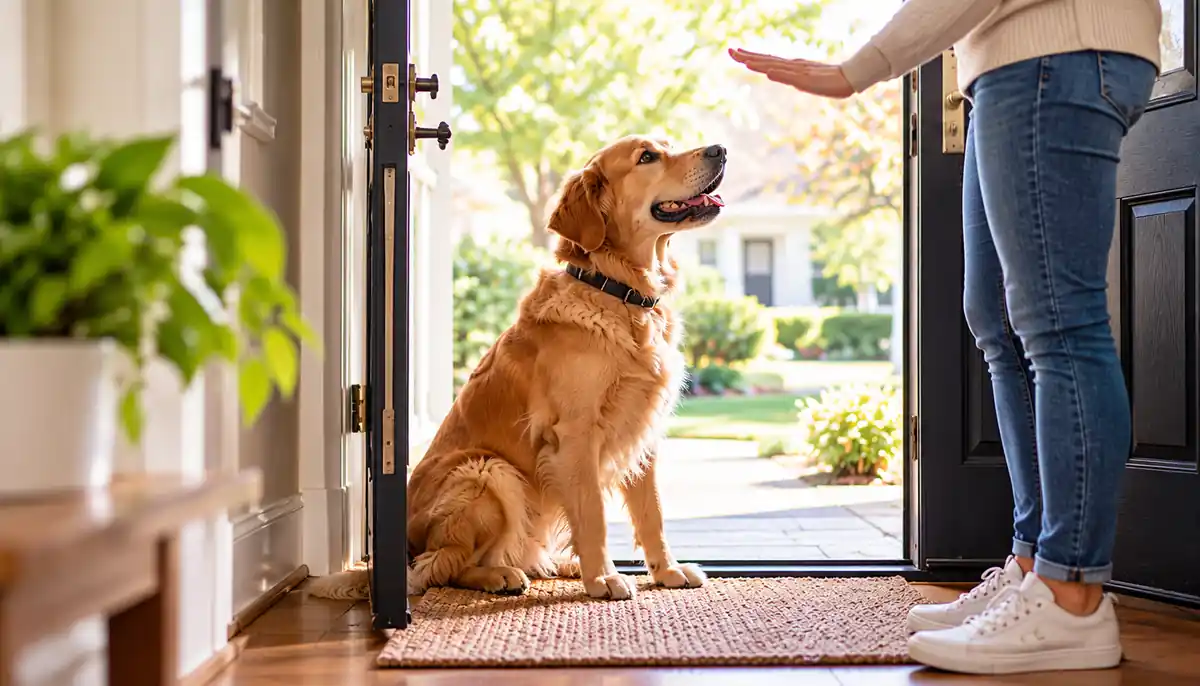
The point of this list is that reinforcement is already happening all day. Training just means noticing what your dog wants and asking for something small before it arrives.
How to shape a dog’s behavior
Shaping in dog training means rewarding small steps that build toward a behavior, instead of waiting for the finished behavior. The AKC describes it as breaking the final behavior into smaller steps rather than teaching it all at once (AKC). It is useful for behaviors your dog rarely offers, or when a lure is not working.
- Decide on the final behavior and break it into steps. For a down, the AKC’s examples of steps include looking at the ground, dropping the nose to the floor and bending the elbows.
- Mark and reward the first step every time it happens. Do not worry about step two until step one is consistent.
- Raise your criteria one step at a time: stop rewarding step one and reward only step two, and so on.
- Keep the pace steady. Skip steps and you will frustrate your dog; stay on one step too long and your dog may think that is all you want.
- Add a cue only once the behavior is reliable.
Free shaping
Free shaping means rewarding behaviors your dog offers on their own, without luring or showing them what to do, and building from there. A classic free-shaping game is Karen Pryor’s “101 Things to Do With a Box”: you reward any interaction with an empty box and see where it goes (AKC). Shaping asks more of the trainer than luring does. The AKC says you need patience, focus and fast rewards, and recommends a clicker or marker word so your dog knows exactly what earned the reward.
A week of practice
| Day | Session focus | Roughly how long |
|---|---|---|
| Monday and Tuesday | Charge the marker, reward ten to fifteen easy repetitions | Two sessions of five minutes |
| Wednesday | Same behavior, new room | Two sessions of five minutes |
| Thursday | Add mild distraction, drop difficulty elsewhere | Two sessions of three minutes |
| Friday | Start varying the reward rather than paying every time | Two sessions of five minutes |
| Weekend | Practice in one new place, keep it short and easy | One short session a day |
Once your dog is reliable at home, apply the same approach to everyday skills: coming when called, walking without pulling on the leash and basic obedience cues.
Positive reinforcement vs. negative reinforcement and punishment
In learning theory, “positive” means something is added and “negative” means something is removed. “Reinforcement” makes a behavior more likely and “punishment” makes it less likely. The words describe what happens, not whether it is good or bad.
| Quadrant | What happens | Dog example | Counted as |
|---|---|---|---|
| Positive reinforcement | Something wanted is added and the behavior increases | A treat for sitting | Reward-based |
| Negative punishment | Something wanted is removed and the behavior decreases | Attention is withdrawn when a dog jumps up | Reward-based |
| Negative reinforcement | Something unpleasant is removed and the behavior increases | Leash pressure stops once the dog sits | Aversive-based |
| Positive punishment | Something unpleasant is added and the behavior decreases | A leash jerk or yelling | Aversive-based |
The grouping and examples come from the AVSAB’s explainer on reward-based methods (AVSAB explainer).
Negative reinforcement is not punishment, because it makes a behavior more likely rather than less. It can change behavior. The catch is that the dog has to experience something unpleasant first. That is why AVSAB groups negative reinforcement with positive punishment as aversive-based, and recommends that only reward-based methods are used for all dog training, including behavior problems.
Aversive methods rely on adding something unpleasant (positive punishment) or removing something unpleasant once the dog complies (negative reinforcement). It can change behavior, which is why it persists. The concerns raised by veterinary behavior bodies are about side effects and about what the dog learns alongside the lesson: AVSAB reports that aversive methods are associated with stress responses, increased anxiety and aggression, and damage to the relationship between dog and owner (position statement), and AAHA’s behavior guidelines take the same evidence-led position (2015 AAHA behavior management guidelines).
| Question | Reward-based approach | Aversive approach |
|---|---|---|
| What the dog learns | What to do instead | What not to do, but not always the alternative |
| Effect on the handler relationship | Handler predicts good things | Handler can predict discomfort |
| Risk with fearful or reactive dogs | Lower, because fear is not added | Higher, because fear can increase |
| Skill required | Timing and reward management | Timing, plus judgement about intensity |
If you are working with a dog who already growls, snaps or panics, this is not a stylistic preference. Get a qualified professional involved before trying anything, such as a veterinarian or a behavior consultant (AVSAB keeps a directory of behavior consultants), and read our guide to aggression in dogs first.
If you are weighing electronic containment systems, our guide to GPS wireless dog fences explains how feedback methods differ between products and what to check before choosing.
Common positive reinforcement training mistakes
- Marking late: a reward that arrives seconds after the behavior reinforces whatever happened last.
- Paying too little for hard work: match the value of the reward to how difficult the situation is.
- Raising difficulty too fast: the AKC warns that skipping steps will only frustrate your dog.
- Rewarding unwanted behavior by accident: attention, treats or access at the moment of barking or jumping up can reinforce them. Reward the behavior you want instead, and manage the setting so the problem is not rehearsed all day.
- Fading food too quickly, or all at once: reduce rewards in stages, as in the table above.
- Expecting a skill to work everywhere: practice in new places gradually. Our guide to training a dog to come when called shows how to build reliability around distractions.
What reward-based training does not fix by itself
Training changes what a dog does. It does not change pain, illness, an unsuitable routine or an environment that keeps rehearsing the problem. A dog who barks at the window all day needs the window managed as well as trained. A dog who suddenly stops responding to a familiar cue may be uncomfortable. Rule out health first, then train.
If you would rather follow a structured course than build a plan yourself, our overview of online dog training programs explains what to ask before paying for one.
Frequently asked questions
Is positive reinforcement the same as permissive training?
No. Reward-based training still has rules, structure and consequences. The difference is that consequences are things like a reward not arriving, rather than pain or intimidation.
Does positive reinforcement work for stubborn breeds?
Reinforcement works across species, not just breeds. A dog who seems stubborn is usually being asked for too much, too fast, for a reward that is not worth the effort.
Can I use praise instead of food?
Praise works once it reliably predicts something good. While a dog is learning, food is usually clearer and faster, because it can be delivered instantly and repeated many times.
What do I do when my dog gets it wrong?
Nothing dramatic. Stay quiet, reset, and make the next repetition easier so your dog can succeed. A missed reward is information, and it is enough.
Will my dog only work when I have treats?
Only if you keep the food visible and predictable. Keep rewards out of sight, vary when they arrive, and pay with real-life rewards too, such as a door opening or a ball thrown.
Does negative reinforcement work on dogs?
It can change behavior, but it works by removing something unpleasant once the dog complies, so the dog has to experience that unpleasant thing first. AVSAB groups negative reinforcement with positive punishment as aversive-based methods and recommends only reward-based training for all dog training.
How does shaping work in dog training?
Shaping rewards small steps toward a final behavior. Break the behavior into steps, reward the first step until it is consistent, then raise the criteria one step at a time without moving so fast that your dog gets frustrated.
How can I avoid rewarding unwanted behavior?
Reward the behavior you want, and avoid giving attention, treats or access at the moment of the unwanted behavior. For example, reward a sit when greeting people and withdraw attention when your dog jumps up, and manage the environment so the problem is not repeated all day.
Related reading: why a dog may suddenly act aggressive.
Final thoughts
Positive reinforcement is a method, not a mood. Mark the behavior you want, pay for it with something your dog actually values, make the exercise easy enough to succeed, then fade the food on purpose. If you want the step-by-step version for a new dog, start with our beginner guide to training a dog, or browse the full dog training hub.