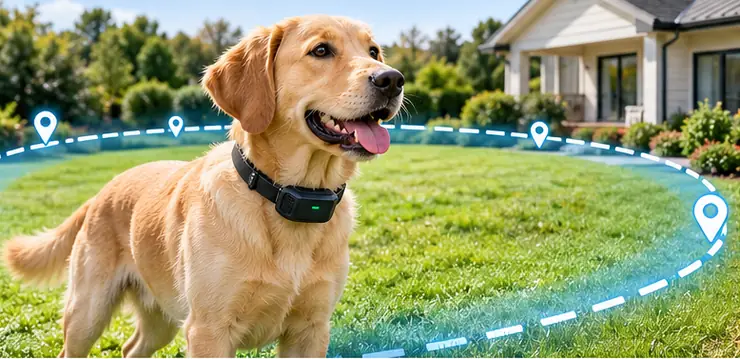
A GPS wireless dog fence is a collar-based containment system that uses satellite positioning to create a virtual boundary around a yard or other outdoor area. When the dog wearing the collar approaches or crosses that boundary, the collar gives feedback, and the dog is trained to respond by moving back. It is not a physical barrier: it cannot stop a dog that crosses the line, and it does not keep people or other animals out.
How a system behaves varies a lot by product, including what kind of feedback it uses, whether it needs Wi-Fi, cellular service or a subscription, and which property and dog sizes it supports. This guide explains how the technology works, where its limits are, and what to check before choosing one. It is educational and research based. PetOwnerHQ has not hands-on tested any GPS fence.
Key takeaways
- A virtual boundary is not a physical barrier. Training, supervision and a safe yard routine still matter.
- Systems differ. Some use tone and vibration, some offer static stimulation, and some let you choose. Verify exactly what the system you are considering does.
- PetOwnerHQ does not recommend aversive training methods, which fits the guidance of veterinary behavior organizations on reward-based training.
- Connectivity and costs vary. Wi-Fi, cellular and subscription needs depend on the model, and the fence and any tracking features may differ.
- GPS accuracy varies with sky view, tree cover, weather and receiver quality, so treat a GPS boundary as a zone, not an exact line.
What Is a GPS Wireless Dog Fence?
A GPS wireless dog fence, also called a GPS dog fence, virtual dog fence or GPS dog containment system, has two core parts: a collar with a GPS receiver, and a virtual boundary saved in the system, usually set up through a smartphone app. “Wireless” means there is no buried wire or fixed transmitter loop around the property.
A few terms are worth defining:
- GPS: satellite-based positioning. The collar estimates its own location from satellite signals.
- Virtual boundary: a line or area saved in the system. It exists only as data, so nothing physical marks it.
- Feedback or correction: what the collar does when the dog nears or crosses the boundary. Depending on the product and its settings, that can be a tone, vibration, static stimulation, or a combination.
- Containment versus tracking: a fence keeps a dog within a boundary, while a tracker shows where a dog is. Some products do only one and some combine both. For the tracking side, see our guides to how pet GPS trackers work and smart dog collars.
How Does a GPS Wireless Dog Fence Work?
In short, you define a boundary, the collar compares its GPS position with that boundary, and it gives feedback as your dog gets close. Your dog then has to be trained to understand what that feedback means.
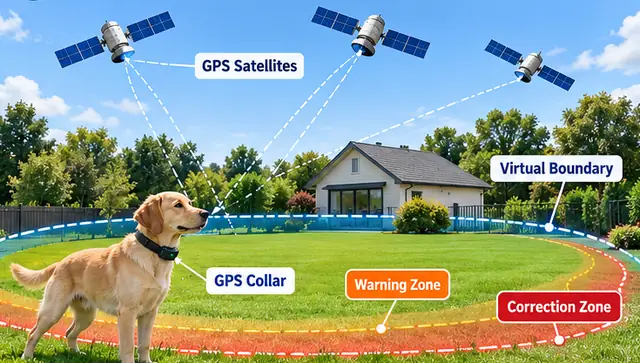
- Set the boundary. Owners typically draw the boundary on a map in an app. Some products, such as SpotOn, also describe walking the perimeter for more precision.
- The collar tracks its own position. Its receiver uses satellite signals to estimate where the dog is and compares that with the saved boundary.
- Feedback starts near the boundary. Many systems begin with a warning before the boundary itself. What follows depends on the system and its settings (see the feedback section below).
- Training teaches the meaning. Manufacturers supply training plans that run over a period of weeks. PetSafe, for example, includes a two-week step-by-step training guide with its Guardian GPS and Tracking collar.
How accurate is GPS for a dog fence?
Accuracy varies, so a GPS boundary is better thought of as a zone than an exact line. The U.S. government’s GPS accuracy page explains that the accuracy a user actually gets depends on factors such as atmospheric effects, sky blockage and receiver quality. PetSafe’s training guidance for its GPS fences makes the same practical point: boundaries are affected by satellite positions and weather, so a dog gets feedback in a general area rather than at an exact spot every time.
Tree cover, buildings and weather can all matter. PetSafe advises starting training on the part of the boundary with the clearest view of the sky.
What Kinds of Feedback Do GPS Dog Fence Collars Use?
It depends on the product. Not all GPS fence systems use the same feedback or correction method, so check exactly what a specific system does before you buy.
| Method | What it is | Notes |
|---|---|---|
| Tone | An audible warning signal. | Often the first cue as a dog approaches the boundary. |
| Vibration | A vibration felt through the collar. | Some systems pair it with tone. Availability varies. |
| Static stimulation | An electrical stimulation delivered through contact points on the collar. | Offered on some systems, sometimes as an optional setting and sometimes at several levels. Veterinary behavior organizations list electronic shock collars among aversive training tools (see below). |
| Combinations | Tone, vibration and static stimulation in sequence or by setting. | Some products let the owner choose which feedback is active. |
For example, PetSafe lists the correction type for its Guardian GPS + Tracking collar as static and tone with vibration, and says owners can choose tone and vibration or ten levels of static. SpotOn describes a warning tone that starts inside the boundary and an optional static correction at the boundary. These are manufacturer descriptions of their own products, not recommendations.
Where PetOwnerHQ stands on aversive methods
PetOwnerHQ does not recommend aversive training methods. That is consistent with our positive-reinforcement approach to dog training.
The American Veterinary Society of Animal Behavior (AVSAB) recommends only reward-based training methods for all dog training and advises that aversive methods should not be used. Its statement lists electronic shock collars among tools that involve pain. The American Animal Hospital Association (AAHA) behavior management guidelines likewise oppose aversive techniques and list electronic shock collars among them.
Two cautions about what those documents say. They address dog training and behavior modification in general and do not evaluate GPS containment systems by name. AVSAB also notes that survey studies linking aversive methods to behavior problems cannot separate cause from correlation. How they apply to a particular fence is a question for your veterinarian or a qualified reward-based trainer.
None of this means every GPS fence is unsafe, or that every GPS fence uses static stimulation. It means you should know which feedback a system uses, and whether a non-static option exists, before you buy.
GPS Wireless Dog Fence vs. a Traditional Fence
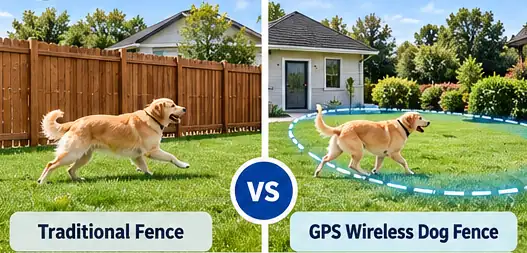
A physical fence blocks movement, while a GPS fence only gives the dog a signal. That difference affects safety, training and what each can protect against.
| Physical fence | GPS wireless dog fence | |
|---|---|---|
| Stops a dog physically | Yes, if it is sound and closed. | No. It relies on the dog responding to feedback. |
| Keeps people and other animals out | Can, depending on design. | No. It only affects the dog wearing the collar. |
| Depends on training | Not for basic containment. | Yes. The dog must be trained to understand the boundary. |
| Depends on power and signal | No. | Yes. The collar needs charge, a fit that works and GPS reception. |
| Boundary shape and changes | Fixed once built. | Often adjustable in an app, depending on the product. |
| Portability | None. | Many systems can save or move boundaries. Varies by model. |
Potential Benefits
For some households a GPS wireless dog fence may offer advantages. Each depends on the system, the property and the dog.
- Flexible boundaries. Many systems let you draw custom shapes and change them in an app.
- No digging or buried wire. Setup is done with the collar and an app, and manufacturers describe setup times ranging from minutes to a couple of hours.
- Portability. Some systems store several boundaries, so the same collar can be used at other locations. The number of saved boundaries varies by model.
- Larger or irregular properties. Some products are designed for acreage where a physical fence may be impractical.
- Optional tracking. Some products add location tracking, usually with extra requirements such as cellular service or a subscription.
Limitations and Safety Considerations
The main limitation is that a GPS fence is not a physical barrier. Suitability depends on the dog, the property, the environment and the system, and training and supervision remain important.
- It cannot physically stop a dog. A dog can cross a virtual boundary, and the system does not keep people, other dogs or wildlife out. No system can promise a dog will never leave.
- Signal quality varies. Tree cover, buildings and weather can affect GPS reception, so boundaries are approximate.
- Training is required. The system only works as intended if the dog has been taught what the feedback means.
- The equipment has to work. The collar needs to be charged, fitted correctly and connected as the manufacturer describes. Ask what happens if it loses GPS signal or the battery runs low.
- Fit and size limits apply. Manufacturers state minimum dog sizes and neck sizes. Examples in the table below range from 15 pounds to over 30 pounds.
- It is not suited to every dog. PetSafe’s guide for its radio-based (non-GPS) wireless fence says not to use that product with aggressive dogs and to talk to a veterinarian or certified trainer if you are unsure. AAHA’s guidelines say aversive techniques are especially injurious to fearful and aggressive animals.
- Property limits apply. Manufacturers state minimum property sizes. PetSafe says that for yards under three-quarters of an acre, or with dense tree coverage, its in-ground or wireless fences may be a better fit for the Guardian GPS + Tracking model.
- Follow the manufacturer’s instructions and keep supervising. Treat the system as one layer of safety, not the only one.
Does a GPS Dog Fence Need Wi-Fi?
Sometimes for setup, but not necessarily afterward. It depends on the model. PetSafe says its Guardian GPS + Tracking collar needs Wi-Fi for setup but not for continued use. Other systems are set up from a phone app alone. Check whether Wi-Fi is needed for setup, for ongoing operation, or not at all.
Does a GPS Dog Fence Need a Cellular Connection?
The fence and the tracking features can have different requirements. SpotOn says its virtual fences do not require a cellular connection, while tracking does. Products that include live tracking generally need cellular coverage for that feature. If you live where coverage is weak, ask which features would be affected.
Can You Use a GPS Dog Fence Without a Subscription?
Some systems work without a subscription, while others require one for tracking features. PetSafe’s comparison lists its Guardian GPS Dog Fence as having no tracking and no subscription, and its Guardian GPS + Tracking model as having tracking with a required subscription. SpotOn says no subscription is required for its core fence features and offers an optional tracking plan for a fee. Check what is included, what costs extra, and what happens to the features if a plan lapses.
How Large an Area Can a GPS Dog Fence Cover?
It depends on the system and the property. Manufacturers state minimum property sizes, and some state very large maximums, so check the specifications for the exact model. As of October 2026, PetSafe lists three-quarters of an acre or more for two of its models and half an acre or more for its Guardian GPS 2.0, and SpotOn recommends a third of an acre or more. Because these figures are manufacturer statements that can change, confirm them on the current product page.
How to Choose a GPS Wireless Dog Fence
- Start with your dog. Consider size, age, temperament, health and how your dog has responded to collars and handling. If you are unsure, ask your veterinarian or a qualified reward-based trainer.
- Look at your property. Check its size, tree cover and nearby hazards. If an escape could put your dog in immediate danger, such as near a busy road, a physical barrier may be the safer choice.
- Decide what you need. Containment only, or tracking as well. Tracking usually adds cellular and subscription considerations.
- Check the feedback options and training approach. See the questions below.
- Read the manufacturer’s documentation. That means the user guide, safety information, training plan, and return and warranty terms.
- Plan for the training period. Allow time for training and supervision before relying on the system.
Important Features to Compare
| Feature | What to check |
|---|---|
| Feedback options | Which of tone, vibration and static stimulation are used, which are on by default, and whether a non-static option is available. |
| Training plan | What it includes, how long it runs, what methods it uses and whether it relies on rewards. |
| Connectivity | Whether Wi-Fi or cellular service is needed for setup, for the fence, or for tracking. |
| Subscription | What is required, what is optional and what happens if a plan lapses. |
| Property requirements | Stated minimum area, and guidance on tree cover and structures. |
| Dog suitability | Stated weight, neck size, age and temperament guidance. |
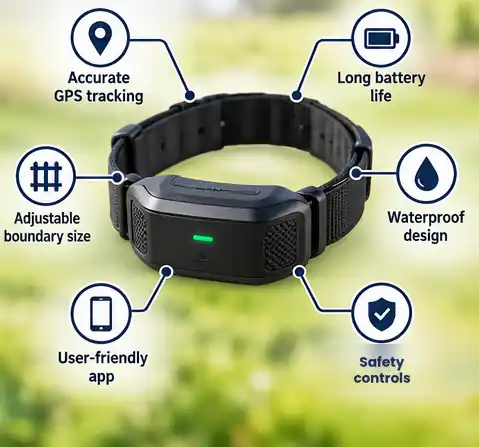
| Battery and charging | Stated battery life, charging method and low-battery behavior. |
| Boundary setup | How boundaries are created and edited, and how many can be saved. |
| Tracking | Whether location tracking is included and what it requires. |
| Support and returns | Current warranty, return window and customer support terms. |
The table below shows how stated specifications can differ even between a few products. These are manufacturer statements as of October 2026, shown as examples of variation rather than recommendations, and they change. Confirm current details with the manufacturer.
| Stated spec | PetSafe Guardian GPS Dog Fence | PetSafe Guardian GPS + Tracking | SpotOn GPS Fence |
|---|---|---|---|
| Feedback | Tone and vibration, or 10 static levels | Tone and vibration, or 10 static levels | Warning tone, with optional static at the boundary |
| Tracking | Not included | Included | Optional plan |
| Subscription | None stated | Required | Not required for core fence |
| Minimum property | 3/4 acre or more | 3/4 acre or more | A third of an acre or more |
| Dog size | Over 25 lb, neck 13 to 28 in | Over 30 lb, neck 15 to 28 in | At least 15 lb, neck 10 in or more |
| Saved fences | 1 | 20 | Unlimited, per manufacturer |
Training Your Dog to Use a GPS Fence
Follow the manufacturer’s training plan step by step, keep sessions short, and build the process around rewards and good handling, not shortcuts.
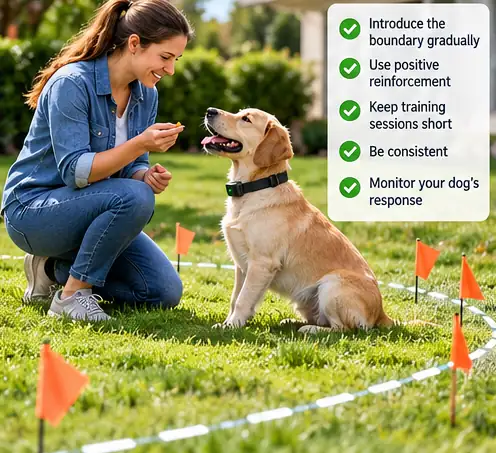
- Read the whole plan first and do not skip or rush stages.
- Start on a leash. Some manufacturer plans use a leash and treats while the dog explores the boundary area, as in PetSafe’s Guardian GPS 2.0 training article.
- Reward the behavior you want. Use treats or play your dog values for turning away from the boundary and coming back to you. Our guides to positive reinforcement and a beginner’s step-by-step approach to training a dog cover the basics, including reliable recall.
- Start where the sky is clearest. PetSafe recommends training at the part of the boundary with the clearest view of the sky.
- Watch your dog’s body language. AAHA lists signs of stress that include lip licking, yawning, panting, a lowered body posture and hiding. If you see them, pause and ask your veterinarian or a qualified trainer for help.
- Keep supervising after training. A trained dog can still cross a virtual boundary.
- Do not use a boundary system to manage aggression or fear. These need professional help. See our overview of aggression in dogs and talk to your veterinarian.
Who Might Benefit From a GPS Dog Fence?
- Owners of larger or irregular properties where a physical fence is impractical.
- Owners who want an adjustable boundary they can move or save for other locations.
- Dogs that are comfortable wearing a collar, fit the manufacturer’s size limits and can complete the training plan.
- Households willing to commit to training time and ongoing supervision.
Who Should Be More Cautious?
- Owners of dogs with a history of aggression, since manufacturers caution against use. Talk to your veterinarian first.
- Owners of fearful or anxious dogs, who should check with a veterinarian or qualified trainer before choosing any system.
- Properties with heavy tree cover, small yards or nearby hazards such as busy roads.
- Very small dogs or puppies who may fall below the manufacturer’s size or age limits.
- Households that need to keep people or other animals out, which a virtual boundary cannot do.
Questions to Ask Before Choosing a System
Practical guidance
Before choosing a GPS containment system, check exactly what feedback/correction methods it uses, whether a non-static option is available, how the system’s training process works, and what the manufacturer recommends.
- What feedback does the collar use, and which is the default setting?
- Is a non-static option available, and can it be set before the first use?
- How does the training process work, how long does it take, and does it rely on rewards?
- What does the manufacturer say about my dog’s size, age and temperament?
- What happens if the collar loses GPS signal, the battery runs low or the app loses connection?
- Which features need Wi-Fi, cellular service or a subscription, and what are the ongoing costs?
- What are the return window, warranty and support options?
Frequently Asked Questions
What is a GPS wireless dog fence?
A GPS wireless dog fence is a collar-based system that uses GPS to create a virtual boundary without buried wire. The collar gives feedback as the dog nears the boundary, and the dog is trained to respond. It is not a physical barrier.
Does a GPS dog fence use a shock?
Not necessarily. Feedback methods vary by product: some use tone and vibration, some offer static stimulation, and some let owners choose. Check the manufacturer’s documentation for the exact system and whether a non-static option is available. PetOwnerHQ does not recommend aversive training methods.
Do GPS dog fences need Wi-Fi or cellular service?
It varies. Some systems need Wi-Fi only for setup, and some need cellular service only for optional tracking features. For example, SpotOn says its virtual fences do not require a cellular connection but tracking does, and PetSafe says its Guardian GPS + Tracking collar needs Wi-Fi for setup but not for continued use. Confirm the details for the model you are considering.
Can you use a GPS dog fence without a subscription?
Some systems work without one, while others require a subscription for tracking features. For example, PetSafe lists its Guardian GPS Dog Fence as subscription-free and its Guardian GPS + Tracking model as subscription required, while SpotOn says no subscription is required for its core fence features. Check what is included and what costs extra.
Is a GPS dog fence as reliable as a physical fence?
No system can guarantee that a dog will stay inside a virtual boundary. A physical fence blocks movement, while a GPS fence relies on signal quality, working equipment and the dog’s training. Treat it as one layer of safety alongside supervision, not a replacement for it.
How do I train my dog to use a GPS fence?
Follow the manufacturer’s training plan step by step, start on a leash, use rewards, and watch for signs of stress. If your dog struggles, pause and ask your veterinarian or a qualified reward-based trainer for help.
Is a GPS dog fence safe for every dog?
No. Suitability depends on the dog, the property, the environment and the system. Manufacturers state size limits, and containment-system guides such as PetSafe’s guide for its radio-based wireless fence caution against use with aggressive dogs. If you are unsure, talk to your veterinarian or a qualified trainer before choosing.
Related reading: stopping a dog from running out the door.
Final Thoughts
A GPS wireless dog fence can give owners of larger or irregular properties a flexible way to define a boundary, but it is a signal, not a barrier. The details that matter most are the ones that vary: what feedback the collar uses, whether a non-static option is available, how training works, what connectivity it needs and what the manufacturer says about your dog’s size and temperament. Check those first, plan for training and supervision, and consider a physical barrier wherever an escape could put your dog in immediate danger. For reward-based basics, start with our guides to positive reinforcement and training a dog, and browse the dog training hub.