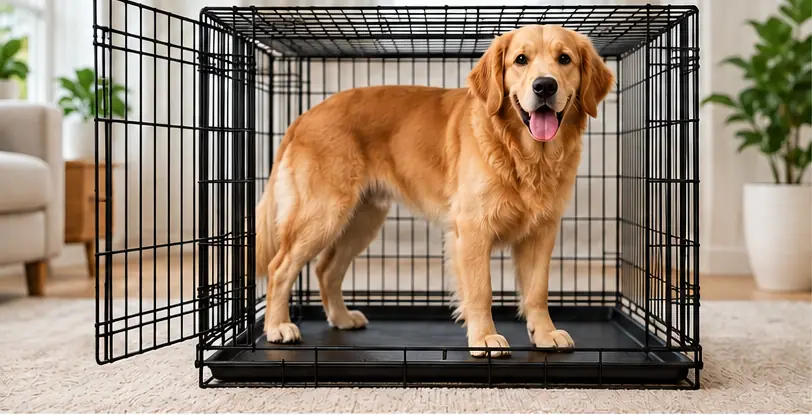
A dog crate size chart matches your dog’s measurements to a crate’s interior dimensions, so the crate is roomy enough to be comfortable without being so big that it stops working. The short answer: measure your dog’s length and standing height, add 3 to 4 inches to each, and choose a crate whose interior is at least that large (American Kennel Club).
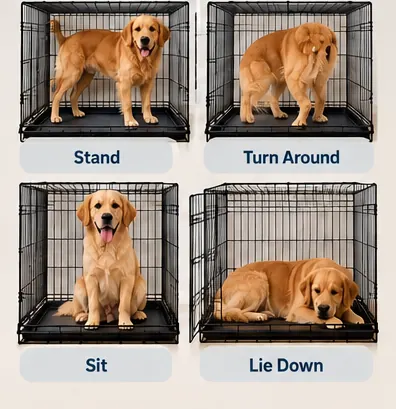
A good fit lets your dog stand, turn around and lie down comfortably. Weight-based charts are a handy shortcut for narrowing down a size, but crate dimensions vary between manufacturers, so your own measurements should make the final call. Below you will find a sample size chart, a step-by-step way to measure, advice for puppies and a plain explanation of how a dog crate divider works.
Key takeaways
- Measure first: take your dog’s length (nose to tail) and standing height, then compare them with the crate’s interior dimensions. Sources disagree on where the length ends, so see the comparison below.
- Add a margin: the AKC suggests adding 3 to 4 inches to both measurements, and PetSmart suggests 2 to 4 inches.
- Use weight as a starting point only: it helps you shortlist a size, but it should not replace measuring.
- Size a puppy’s crate for the adult dog: use a divider to shrink the usable space until your puppy grows into it.
- Between sizes? Check both length and height against the interior dimensions. If the smaller crate falls short on either, go up a size.
Dog Crate Size Chart
Size names and weight ranges differ by brand. As an example of how sizing commonly works, the table below shows the sizes one large pet retailer uses. Treat it as a starting point, not a standard.
| Crate size | Dog weight | Typical crate length |
|---|---|---|
| Extra small | Under 10 lb | 18 to 22 inches |
| Small | 11 to 25 lb | 24 to 30 inches |
| Medium | 26 to 40 lb | 30 to 36 inches |
| Large | 41 to 70 lb | 36 to 42 inches |
| Extra large | 71 to 90 lb | 42 to 48 inches |
| XXL | 91 lb and up | 48 to 54+ inches |
Why there is no single universal chart: size names and weight ranges are set by each manufacturer. Compare the interior length, width and height in inches, not the size name.
If your dog sits near the top or bottom of a weight range, or has an unusually long body or tall frame for their weight, rely on the measuring steps below. Those numbers matter more than the label.
How to Measure Your Dog for a Crate
You need a soft measuring tape, a few treats to keep your dog still and, ideally, a helper. Measure with your dog standing in a natural position on all four paws.
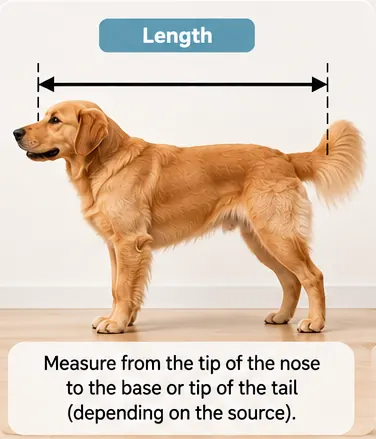
- Length: measure from the tip of the nose to the base of the tail (Whole Dog Journal and PetSmart) or to the tip of the tail (AKC). Pick one method and use the matching margin in step 3.
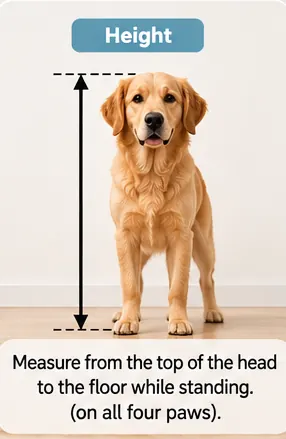
- Height: measure from the floor to the top of the head, with the head held comfortably. If your dog’s ears stand taller than the head, PetSmart suggests measuring to the ear tips.
- Add extra room: the AKC adds 3 to 4 inches to its length (nose to tail tip) and height measurements. PetSmart adds 2 to 4 inches to a length that stops at the tail base, and Whole Dog Journal says to look for a crate several inches longer and taller than your dog. The totals are your minimum interior length and height.
- Allow for bedding: a mat or bed can take up about an inch of height, so keep that in mind if the crate is a close fit.
- Compare: check the interior dimensions on the product page, and look for any measuring instructions the manufacturer gives.
Where the sources differ
| Question | AKC | Whole Dog Journal | PetSmart |
|---|---|---|---|
| Length ends at | Tip of the tail | Base of the tail | Base of the tail |
| Height measured | Top of the head to the bottom of the feet | Floor to the top of the head, held comfortably | Floor to the top of the head or ear tips, whichever is taller |
| Extra room | Add 3 to 4 inches to each measurement | Several inches longer and taller than the dog | Add 2 to 4 inches to each measurement |
These are different methods, not identical ones, so do not mix them. Pair the AKC’s tail-tip length with its 3 to 4 inch margin, or a tail-base length with the margin its source suggests. Measuring to the tip of the tail gives a longer number. When in doubt, follow the instructions on the crate manufacturer’s product page.
How Much Extra Space Should a Dog Crate Have?
Enough for your dog to stand, turn around and lie down comfortably, and not much more. The AKC suggests a margin of 3 to 4 inches over your dog’s measurements, and PetSmart suggests 2 to 4 inches.
| Fit | What it looks like | Why it matters |
|---|---|---|
| Too small | Your dog hunches, cannot turn around easily or cannot stretch out when lying down | A crate that is too small can cause stress and discomfort |
| About right | Your dog stands without the head touching the top, turns around and lies down with the legs extended | This is the target fit |
| Too large | A lot of empty floor space beyond the area your dog needs | A dog may use one end to eliminate, and may feel less secure |
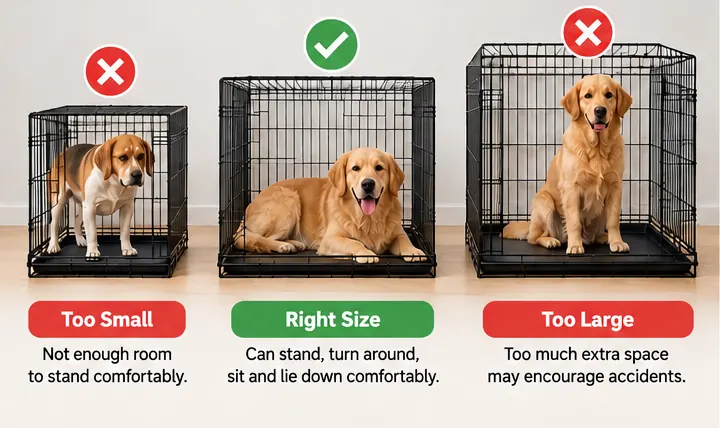
A crate that is too large can often be fixed with a divider, which is covered below.
Dog Crate Size by Weight
Many manufacturers list a dog weight range for each crate size, and a weight-based chart is a reasonable way to shortlist options. Whole Dog Journal cautions against going by weight alone, because some dogs need more space than others even within the recommended range. Two dogs of the same weight can have very different heights and body lengths.
Use weight to pick a size to look at, then confirm it with your length and height measurements. If the two disagree, trust the measurements.
Dog Crate Size by Breed
Breed gives a rough idea of adult size, but it is a weak basis for choosing a crate. Dogs of the same breed differ in height, body length, build and age, and mixed-breed dogs do not follow a breed standard at all. A long-bodied dog and a tall, narrow dog can weigh the same and still need different crates.
For that reason this guide does not list crate dimensions by breed. For a puppy, the typical adult size of the breed can help you plan ahead, and the AKC suggests an expandable crate that is as large as that typical adult size. Measure your dog once fully grown to confirm the fit.
What Size Crate Does a Puppy Need?
Buy for the size your puppy will be as an adult, then use a divider to shrink the usable space for now. The AKC recommends an expandable crate that is as large as the typical adult size for your dog’s breed, with a divider you move as your puppy grows.
PetSmart notes that a crate sized for a young puppy is quickly outgrown, so you may end up buying more than one. The AKC adds that too much open space can encourage a dog to eliminate in the crate, which is why the divider matters.
Puppies grow at different rates, so recheck the fit regularly. Your puppy should still be able to stand, turn around and lie down comfortably in the section you leave open. If you are just getting started, our puppies and puppy training pages are good next stops.
How Does a Dog Crate Divider Work?
A dog crate divider is a panel that fits inside a crate and splits it into two sections. Your dog uses one section and the rest is closed off, so a large crate has a smaller usable area. As your puppy grows, you move the panel back to open up more space. PAWS Chicago notes that some wire crates come with a divider that expands the size of the crate, which can save money when training a growing puppy.
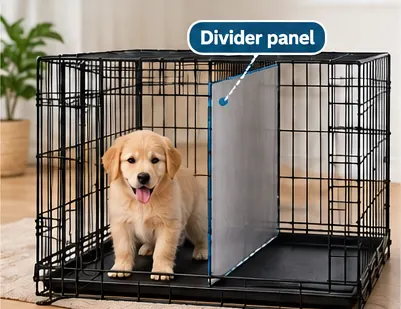
- One crate, several stages: a dog crate with a divider can fit a puppy now and an adult later.
- Snug usable space: closing off the spare room avoids the “too large” problem described above.
- Check the listing: not every crate includes a divider, so confirm it before you buy and follow the manufacturer’s instructions for fitting it.
What If My Dog Is Between Crate Sizes?
Work out your minimum interior length and height (your dog’s measurement plus the margin), then compare them with the interior dimensions listed for each of the two sizes. The smaller size works only if both its length and its height meet or beat your minimums. If it falls short on either one, go up a size. PetSmart’s guidance is to size up when in between, since a little extra room is better than a cramped space.
If the larger crate feels too roomy, a divider can close off the extra space, and bedding or a blanket can make it cozier.
Common Dog Crate Sizing Mistakes
- Choosing only by weight: weight ranges are a guide, and dogs of the same weight can need different amounts of space.
- Choosing only by breed: individual dogs vary widely within a breed.
- Ignoring manufacturer dimensions: size names and weight ranges differ by brand.
- Buying too small: your dog should be able to stand, turn around and lie down comfortably.
- Buying excessively large: too much empty space can encourage a dog to eliminate in the crate.
- Forgetting puppy growth: a crate sized for a young puppy is quickly outgrown.
- Skipping the usable interior dimensions: check whether the listing shows interior or exterior dimensions, and remember that bedding takes up room.
What to Check Before Buying a Dog Crate
- Interior dimensions: length, width and height in inches, compared with your dog’s measurements plus margin.
- Manufacturer’s sizing guidance: the weight range and any measuring instructions on the product page.
- Door placement: make sure the door opens where you have room for it.
- Construction and material: the AKC describes plastic, metal, wood and soft crates, and says the right choice depends on your budget, whether your dog chews and how you plan to use the crate.
- Ventilation: the AKC says every crate needs ventilation holes or mesh sides so your dog can breathe properly.
- Cleaning: plastic crates are easy to clean, while soft crates are harder to clean after an accident, according to the AKC.
- Portability: if you plan to travel, check the airline’s own crate requirements and see our dog travel page.
- Divider availability: especially important for puppies.
Once the crate is sized, add a comfortable mat or bed (see our dog beds page) and make the crate a positive place with reward-based methods, as described in our guide to positive reinforcement dog training. For a wider look at a safe home, see our pet safety at home checklist.
Frequently Asked Questions
Should I measure my dog sitting or standing for a crate?
Standing. The American Kennel Club, Whole Dog Journal and PetSmart all describe measuring height with the dog standing, from the floor to the top of the head (PetSmart adds the ear tips if they are taller). Some manufacturers give their own measuring instructions, so check the product page before you order.
How do I know if a dog crate is too small?
Your dog should be able to stand without hunching, turn around, sit, and lie down with the legs stretched out. If your dog looks cramped or hunched, or cannot move comfortably, the crate is too small.
Should I include a bed or mat when sizing a crate?
Yes, plan for it. Whole Dog Journal notes that a mat or bed can take up about an inch of height, so leave room for bedding on top of your measurements.
Do wire, plastic and soft crates come in the same sizes?
Size labels can mean different things from one brand to the next, so do not rely on the label or the crate type alone. Compare your dog’s measurements with the interior length, width and height on the product page, and check whether the listed dimensions are interior or exterior.
Related reading: beginner dog training steps and dog separation anxiety.
Final thoughts
The most reliable way to size a dog crate is to measure first. Take your dog’s length and standing height, add a few inches, leave room for bedding and compare the result with the manufacturer’s interior dimensions. Use weight and breed to narrow your options, and use a divider to make a larger crate work for a growing puppy. For more help with training and daily care, browse our dog training hub.