Barking is not one behavior. A dog barking at the window, a dog barking for your attention and a dog barking because they cannot reach something all look similar and need completely different fixes. Working out which one you have is most of the job.
Key takeaways
- Identify the type first: the same bark has at least seven different causes.
- Manage the trigger: blocking the view or the sound does more than any cue.
- Reward the quiet: most dogs are only noticed when they are loud.
- Skip the bark collar: the ASPCA does not recommend them as a first choice.
The short answer
Dogs bark because it works. It moves the delivery driver along, it brings you into the room, it releases tension when something is out of reach. To change it, you need to know which of those is happening, then change the payoff and the opportunity at the same time.
The seven kinds of barking
The ASPCA groups barking into categories that each need their own approach (ASPCA on barking). Finding yours narrows the problem quickly.
| Type | What it looks like | Where it happens |
|---|---|---|
| Territorial | Defending space from people or animals | Home, yard, car, familiar places |
| Alarm | Reaction to an unexpected sight or sound | Anywhere, often with a startle |
| Attention seeking | Directed at you, pausing to check the effect | Wherever you are |
| Greeting | Loose, wiggly body, often with a toy | Doors, gates, arrivals |
| Compulsive | Repetitive, often with pacing or spinning | Usually alone, without an obvious trigger |
| Socially facilitated | Starts when other dogs bark | Gardens, kennels, neighborhoods |
| Frustration induced | Confined or blocked from something wanted | Behind gates, windows, fences, on lead |
Work out which one you have
Four questions usually settle it. What was happening in the two seconds before the first bark? Where was your dog looking? What ended the barking? And does it happen when you are out of the house? An attention bark stops when you engage. An alarm bark stops when the sound does. A frustration bark carries on until the barrier moves.
Fixes by type
Territorial and alarm barking
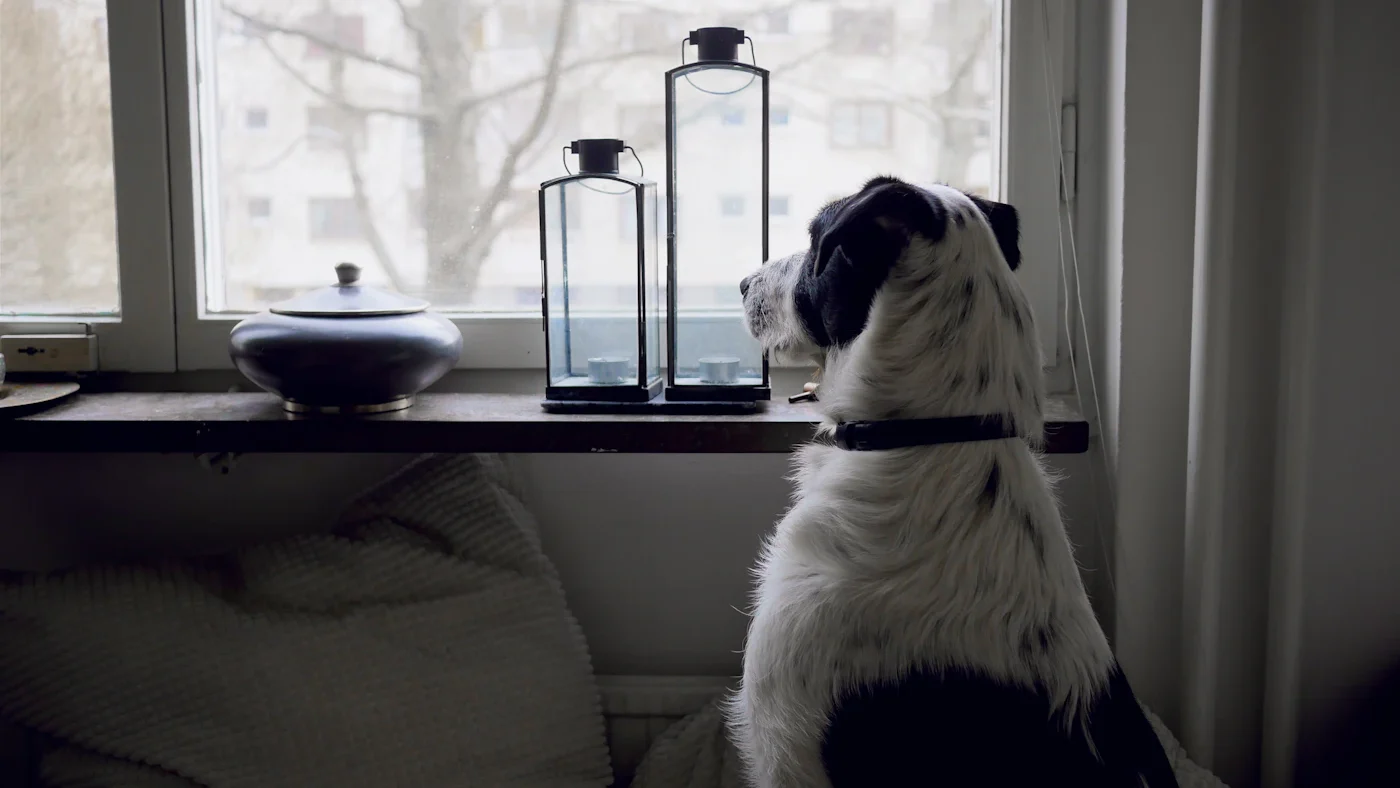
Start with the view and the sound. Frosted film on the lower half of a window, a closed blind, or moving the dog’s bed away from the front of the house removes most of the opportunity. Then teach an alternative: a treat scattered on the floor every time the trigger appears, before your dog starts, so the trigger begins to predict food rather than a confrontation.
Attention barking
The rule is simple and hard to keep: the bark never works, and quiet always does. Wait for a pause, however short, then respond. Expect it to get louder before it gets better, because your dog will try harder at first.
Frustration barking
This one is about the barrier. A dog who barks at the gate is telling you the arrangement is not working. Reduce the time spent behind it, give something to do while there, and where possible remove the sight of whatever is out of reach.
Greeting barking
Give the mouth a job. A toy to carry at the door, or food scattered as the visitor enters, occupies the same moment and lowers arousal at the same time.
Management while you train
- Block sightlines rather than relying on a cue your dog cannot hear yet.
- Use background sound to mask street noise if alarm barking is the problem.
- Move the dog away from the front of the house when you are out.
- Give a long chew at the times of day the barking usually starts.
- Do not let the dog rehearse in the yard unsupervised if the yard is where it happens.
What to do about the neighbors
Barking complaints are what push most owners to look for a fix, and they change the timeline, because you are usually trying to reduce noise this week rather than in six. Management does that work, training does not.
Find out when the barking happens when you are out. A phone propped up in the room, or a cheap camera, will tell you in one day what guessing will not tell you in a month. Once you know the window, you can act on it: move the dog to a quieter room, close the blinds, leave a chew timed for that hour, or arrange a midday visit if the barking is boredom.
It is also worth talking to the neighbor before they talk to the council. Most people are far more patient with a problem they know is being worked on, and they can tell you exactly when it happens, which is information you cannot get any other way.
Why bark collars are a poor first choice
The ASPCA is direct about this: anti-bark collars are punishment devices and are not recommended as a first choice, and virtually all dogs become collar-wise, reverting to barking once the collar comes off (ASPCA). There is also the wider point that veterinary behavior organizations recommend reward-based methods for all dog training, including behavior problems, and report that aversive tools are associated with increased anxiety and aggression (AVSAB, 2021). A dog barking out of fear who is then punished for barking usually becomes more fearful, not quieter.
Barking at other dogs on walks
This one deserves separating out, because it is usually frustration or fear rather than the household barking above, and the fix is different. A dog who barks and lunges on lead at the sight of another dog is normally over threshold before the barking starts, which means no cue you have taught is available to them in that moment.
Work on distance rather than obedience. Find the range at which your dog can still notice the other dog and take a treat, and stay there. That distance is your working range. Feed while the other dog is visible and stop when it passes, so the other dog predicts food rather than tension. Over weeks the range shrinks, and it shrinks faster if you never push it.
Cross the road, turn early or step behind a parked car rather than walking past at close quarters. Avoiding a rehearsal is progress, even though it does not feel like training.
When barking is a health sign
Raise it with your vet if the barking is new in an adult dog, if it happens at night in an older dog, or if it has the repetitive, hard-to-interrupt quality of compulsive barking. Illness, pain and cognitive change can all show up as vocalising, and behavior changes are worth a medical look before a training plan (Merck Veterinary Manual). Barking that happens only when you are out, alongside pacing or damage, points towards separation anxiety rather than ordinary barking. Our guide to the signs of dog separation anxiety and how gradual training works explains how to tell the difference.
A realistic timeline
| Type | What usually changes first | Rough timeline |
|---|---|---|
| Attention barking | Shorter bursts, longer pauses to check | One to three weeks of full consistency |
| Greeting barking | Quieter once the routine is predictable | Two to four weeks |
| Territorial and alarm | Fewer episodes once the view is managed | Several weeks, longer without management |
| Frustration | Improves as the barrier time drops | Depends mostly on the setup, not the dog |
K9 Training Institute
Video-led training covering barking and everyday obedience problems.
Link coming soonBrain Training for Dogs
Focus and impulse-control games that support quiet behavior.
Link coming soonWe link to programs so you can check current details yourself. We do not publish prices or course contents, because those change.
Frequently asked questions
Why does my dog bark at nothing?
Dogs hear and smell far more than we do, so alarm barking often has a trigger you have not noticed. Compulsive barking, which is repetitive and happens without an obvious cause, is a separate pattern worth raising with a vet.
Do anti-bark collars work?
The ASPCA describes them as punishment devices and does not recommend them as a first choice, partly because most dogs become collar-wise and go back to barking once the collar is off.
Is it cruel to stop a dog barking?
No, as long as you are changing the reason rather than suppressing the sound. Barking is communication, and a dog who is barking from fear or frustration needs the underlying cause addressed.
How long does it take to reduce barking?
Weeks for attention barking, longer for territorial and alarm barking, because those involve emotion as well as habit. Consistency matters more than intensity.
My dog only barks when I am out. What now?
Barking that happens only in your absence, especially with pacing or destruction, points towards separation-related distress rather than ordinary barking.
Related reading: daily dog exercise ideas, positive reinforcement dog training and why a dog may suddenly act aggressive.
Final thoughts
Name the type, remove the opportunity, and pay for the quiet. That order solves most household barking without any equipment at all. If the barking only happens when you leave, start with our guide to separation anxiety in dogs instead, and for everything else our dog behavior hub has the related guides.